Blog
How to Choose a Laundry Detergent Formula: Powder vs Liquid vs Pods

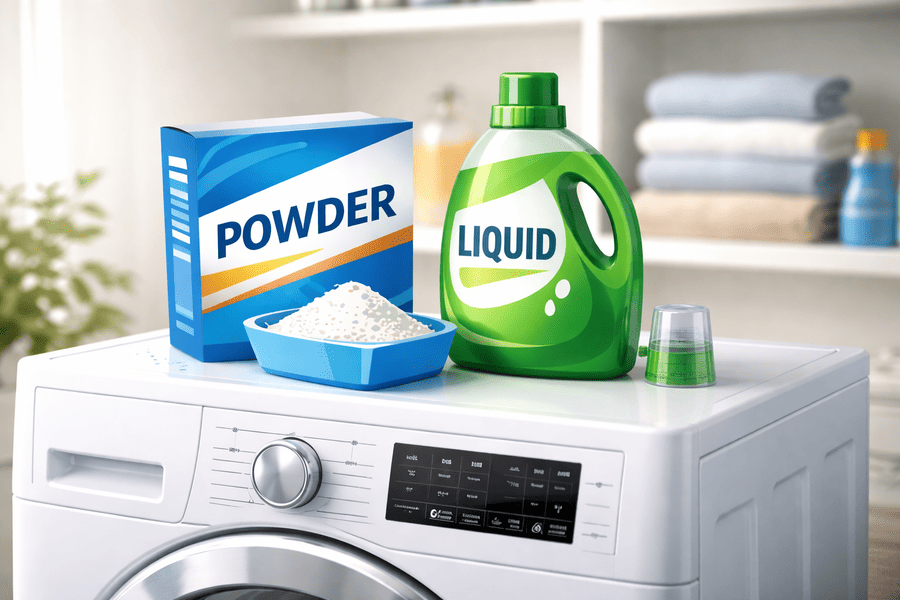
Picking a laundry detergent format is not a branding decision only. It is a formulation decision first. Because the format sets your chemistry limits, your packaging risk, and your cost per wash. This guide helps you choose between powder, liquid, and pods. It also shows what to test before you scale. If you sell under private label, these checkpoints save months.
Start with six questions
Before you compare formulas, define your target. Otherwise, you will compare the wrong tradeoffs.
- Who will buy it? Mass market, eco, premium, or institutional.
- How do they wash? Cold cycles, short cycles, or heavy soil cycles.
- What is the water like? Soft, medium, or hard water.
- What is your cost target? Cost per wash matters more than cost per kg.
- What claims must you support? Fragrance-free, color-safe, enzyme, eco, etc.
- What packaging fits your channel? E-commerce needs stronger packaging.
Keep those answers visible. Then compare the formats.
Quick comparison: where each format wins
| Decision factor | Powder | Liquid | Pods / capsules |
|---|---|---|---|
| Best for hard water | Strong | Medium | Medium |
| Best for oxygen bleach | Strong | Weak–Medium | Medium |
| Best for premium scent | Medium | Strong | Strong |
| Shipping efficiency | Strong | Weak | Medium |
| Shelf stability risk | Moisture | Micro + phase | Moisture + film |
| Manufacturing complexity | Medium | Low–Medium | High |
| Dosing convenience | Medium | Strong | Strong |
Now let’s break down what this means in practice.
Powder detergent formulations
Powder often delivers the highest “active load” for the price. It can also carry strong builders and oxygen bleach systems. Therefore, it performs well on whites and heavy soils.
When powder is the best choice
Choose a powder detergent formula if you want:
- Strong performance in hard water
- Better stain removal with oxygen bleach
- Lower freight cost, because you do not ship water
- Long shelf life with simple preservation needs
This is also why many brands use powder for cost optimization.
What the formula can include
Powder systems can include high levels of:
- Builders (for example, carbonate and silicate systems)
- Oxygen bleach (for example, percarbonate-based systems)
- Enzymes (granulated grades work well)
- Anti-redeposition polymers and soil release aids
Because the format stays dry, you can protect many actives more easily.
Main risks for powders
Powder’s main enemy is moisture. If the product picks up humidity, it can cake, lose flow, and reduce performance. In addition, oxygen bleach can degrade faster with moisture.
So focus on:
- Moisture barrier packaging
- Flow aids and anti-caking strategy
- Dust control and user experience
- Stability checks at higher humidity
Powder vs liquid debates often end here. Powder performs well, but it needs moisture discipline.
Liquid detergent formulations
Liquid sells convenience. It also allows stronger fragrance expression. Moreover, it feels “premium” to many buyers, even at similar performance.
When liquid is the best choice
Choose a liquid detergent formula if you want:
- Strong convenience for daily loads
- Better “sensory” profile, especially fragrance
- Easy dosing with caps or pumps
- Simple line setup compared with pods
Liquid also supports many “gentle” narratives. However, you must manage stability.
What the formula can include
Liquids usually rely on:
- Surfactant blends for soil removal
- Water conditioners and chelators for hardness control
- Enzymes (if you protect them well)
- Polymers for anti-redeposition and feel
You can build a strong liquid, but you must balance viscosity and clarity.
Main risks for liquids
Liquids face different problems than powders:
- Microbial control, because water supports growth
- Phase separation, especially with high fragrance loads
- Viscosity drift when salts or electrolytes vary
- Freeze–thaw damage in cold logistics
Therefore, you need preservative strategy and stability testing. Also, you must lock your raw material specs early.
Pods and capsule detergent formulations
Pods win on dosing precision. They also support premium pricing. In addition, they simplify the user routine, which boosts repeat purchase.
Yet pods raise technical and operational complexity.
When pods are the best choice
Choose detergent pods if you want:
- Premium positioning with high convenience
- Fixed dosing for controlled cost per wash
- Compact packaging for retail impact
- A modern “innovative” product story
Pods also reduce messy handling. That matters for many consumers.
What the system requires
Pods combine two worlds:
- A concentrated internal formula (often liquid or gel)
- A water-soluble film and compatible packaging
So you must test:
- Film compatibility with the internal formula
- Seal integrity and leakage resistance
- Dissolution speed in cold and short cycles
- Moisture control during storage
Pods can deliver strong performance. However, they demand strict quality control.
Main risks for pods
Pods fail when moisture enters the system. Also, they fail when the film and formula fight each other. Meanwhile, production errors can raise scrap quickly.
So plan for:
- Low-humidity production and packing
- Tight specs for film, temperature, and sealing
- Transport tests, including compression and vibration
- Child-safe and channel-safe outer packaging
If you plan private label pods, you must align on packaging early.
Performance: what matters most in real washing
A “laundry detergent formulation” succeeds when it performs across water types and soils. Format alone does not guarantee performance. Instead, your active system does.
Use these performance lenses:
1) Water hardness control
Hardness steals surfactant efficiency. So builders and chelators matter. Powders usually lead here. Liquids can compete, but the builder system is narrower.
2) Stain mix
Kitchen soils, body oils, and pigments behave differently. Therefore, blend surfactants and enzymes for your target stains. If you target whites, oxygen bleach becomes a big lever.
3) Cold and short cycles
Modern washing shifts to cold and quick cycles. Liquids and pods often dissolve faster. Powders can also work, but you must design for fast wetting and dispersibility.
4) Residue and rinse feel
Residue hurts brand trust. So test on dark fabrics. Also test in low-water machines. Low residue supports a premium story.
Cost: think in “cost per wash,” not “cost per kg”
Many buyers compare prices per kg. That can mislead. Because each format uses different dosing.
Use a simple model:
- Dose (g) × cost per kg = cost per wash
- Then add packaging + freight + returns risk
Powder often wins freight. Liquid often wins user preference. Pods often win pricing power, but they also raise packaging cost.
If you aim for cost optimization, do not skip this step.
Manufacturing and scale-up reality
Formulation selection should match your production capability.
Powder production reality
Powder can be blended, agglomerated, or spray-dried. Each route changes cost and particle behavior. Also, dust and moisture control matter.
Plan for:
- Consistent bulk density
- Good flow in filling lines
- Stable perfume handling if you add it later
Liquid production reality
Liquids are easier to mix. However, viscosity and foam can slow production. Mixing order matters a lot.
Plan for:
- Clear mixing SOP
- Viscosity target window
- Defoaming strategy
- Packaging compatibility tests
Pods production reality
Pods require dedicated equipment and humidity discipline. Quality checks must run continuously. Otherwise, scrap rises fast.
Plan for:
- Sealing validation
- Leak testing
- Dissolution testing
- Transit testing
A practical decision guide
Choose powder if:
- You want the best value for whites and heavy soils
- You expect harder water markets
- You want low shipping cost and strong margin control
Choose liquid if:
- Convenience and fragrance drive purchase
- You target cold wash and daily loads
- You want simpler operations than pods
Choose pods if:
- You want premium pricing and dosing control
- You can support higher packaging and QC needs
- You want a modern retail story
This is the clearest path through “powder vs liquid vs pods.”
What to test before launch
Do not launch based on a bench sample only. Instead, run a short test list.
For powders:
- Humidity stability and caking
- Flow and dust behavior
- Bleach stability if used
- Wash performance at low temperature
For liquids:
- Micro test plan and preservative performance
- Viscosity drift over time
- Freeze–thaw stability
- Fragrance separation risk
For pods:
- Dissolution in cold and short cycles
- Leak resistance and seal integrity
- Moisture pickup in storage
- Pack integrity in transport
Testing protects your private label promises. It also reduces returns.
Final takeaway
There is no single “best” detergent format. The best choice depends on water, wash habits, cost per wash, and packaging reality. Powder often wins on performance-to-cost. Liquid often wins on user experience. Pods often win on premium positioning and dosing control.
If you want, you can publish one “format guide” article and then link to three product pages: powder formulations, liquid formulations, and pod-ready concentrates. This structure supports both SEO and conversion for FormulationMarket.