Blog
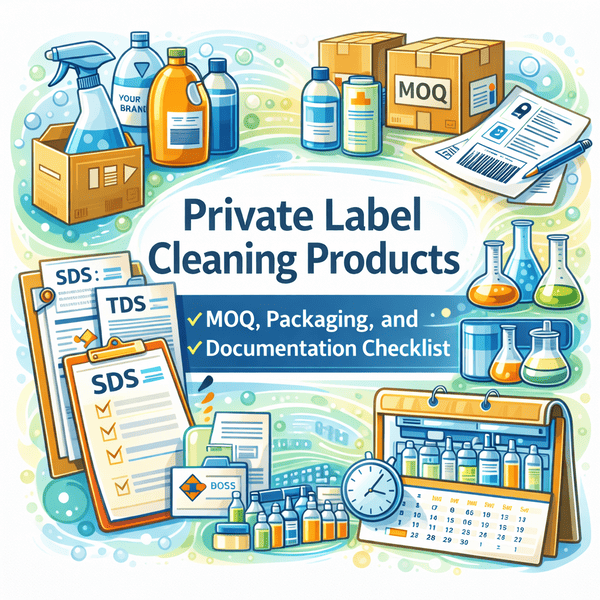
Private Label Cleaning Products: MOQ, Packaging, and Documentation Checklist

Private label cleaning products offer brands a fast and flexible way to enter the market without investing in their own manufacturing infrastructure. However, many projects fail or stall not because of product quality, but because expectations around minimum order quantities, packaging options, and documentation are not clearly understood from the start. This guide explains how private label cleaning projects work in practice and outlines the key checkpoints you should review before requesting prices or samples. Throughout the article, bold, link-ready phrases are included so you can connect readers to relevant pages on your site.
At the core of any private label project is the balance between customization and feasibility. Manufacturers already operate validated base formulas, approved raw materials, and proven processes. Private label development usually starts from these existing systems rather than from a blank sheet. Understanding this reality helps brands make smarter decisions early, especially when reviewing private label cleaning products and ready-to-scale detergent formulations.
Understanding MOQ in Private Label Cleaning
Minimum order quantity, or MOQ, is often the first friction point in private label discussions. MOQ exists because manufacturers must secure raw materials, schedule production lines, and run quality controls that only make sense above certain volumes. Importantly, MOQ is rarely a single fixed number. It varies based on product type, packaging format, and level of customization.
Liquid detergents, for example, may have lower MOQs when filled into standard bottles already used by the factory. Powders often require higher MOQs due to batch size limitations and packaging setup. Sachets, pods, or PVA-based formats typically carry higher MOQs because of specialized machinery and packaging materials. Fragrance customization, color changes, or unique performance claims can also increase MOQ thresholds. This is why brands benefit from reviewing MOQ planning for private label detergents before locking in a concept.
MOQ should also be viewed strategically rather than defensively. A lower MOQ with a non-optimized cost structure can be more expensive per unit than a slightly higher MOQ with better economies of scale. Experienced buyers compare total landed cost, not just entry volume, when evaluating offers.
Packaging Choices: Where Cost and Branding Intersect
Packaging is one of the most influential decisions in a private label cleaning project. It affects cost, shelf presence, logistics, and regulatory compliance. Manufacturers typically offer a range of standard packaging formats such as bottles, jerrycans, doypacks, sachets, or bulk containers. Using existing molds and packaging lines keeps MOQs and lead times manageable, especially for first orders.
Custom packaging, such as unique bottle shapes or proprietary closures, provides stronger brand differentiation but comes with higher tooling costs and longer timelines. In many cases, brands launch with standard packaging and move to custom molds once volumes justify the investment. This phased approach aligns well with packaging selection for cleaning products and cost-optimized private label strategies.
Material choice is equally important. HDPE, PET, glass, kraft paper, or PVA-based packaging each have implications for chemical compatibility, sustainability positioning, and transport safety. Packaging must also protect the product throughout its shelf life, especially for enzyme-based or moisture-sensitive formulations. Linking packaging decisions to detergent stability requirements helps avoid costly reformulations later.
Documentation: The Non-Negotiable Foundation
Documentation is often underestimated by new private label brands, yet it is essential for sales, distribution, and regulatory approval. At a minimum, private label cleaning products require a Safety Data Sheet (SDS) and a Technical Data Sheet (TDS). These documents describe composition, hazards, usage instructions, and storage conditions, and they are frequently requested by distributors and importers.
Depending on the market, additional documents may be required, such as Certificates of Analysis (COA), ingredient disclosures, or regulatory notifications. Export markets may demand localized SDS versions, specific labeling elements, or compliance with regional chemical regulations. This is why early alignment on private label documentation requirements and SDS and TDS preparation saves time and prevents last-minute delays.
Documentation also supports credibility. Buyers, retailers, and B2B customers rely on technical documents to assess product suitability. A well-prepared documentation package signals professionalism and reduces friction in commercial discussions.
Samples, Lead Times, and Commercial Readiness
Samples play a critical role in private label development, but they should be approached with clear intent. Samples are typically produced from existing formulations and packaging, meaning they represent performance rather than full customization. Brands should use samples to validate cleaning efficiency, fragrance acceptance, and basic compatibility, not to fine-tune every parameter.
Lead times depend on raw material availability, packaging stock, and production scheduling. Standard products with existing packaging can often be produced faster, while customized projects require additional coordination. Clear communication around timelines aligns expectations and supports smoother launches. These steps naturally connect to private label project planning and production lead time management.
Common Mistakes to Avoid
Many private label projects struggle because of unclear priorities. Attempting to minimize MOQ while demanding full customization usually leads to delays or inflated pricing. Similarly, choosing packaging based solely on appearance without considering chemical compatibility can result in stability failures. Another common issue is postponing documentation discussions until after samples are approved, which can delay sales or export approvals.
Successful private label brands approach development as a system. They align MOQ, packaging, formulation, and documentation decisions from the beginning and adjust complexity as volumes grow. This mindset fits well with scalable private label cleaning products and long-term formulation strategies.
Final Thoughts
Private label cleaning products offer a powerful route to market, but success depends on preparation rather than speed alone. Understanding how MOQ is determined, choosing packaging that balances branding and feasibility, and securing the right documentation early all contribute to smoother launches and stronger partnerships with manufacturers. When these elements are treated as a checklist rather than obstacles, private label development becomes predictable, scalable, and commercially viable.


