Blog
Niacinamide 10% + Zinc Serum: Benefits, Skin Types, Ingredients and Cosmetic Product Development

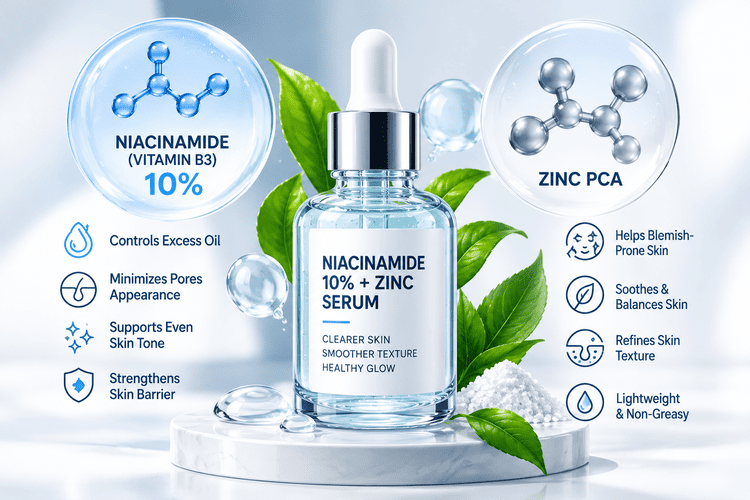
Niacinamide 10% + Zinc Serum is a popular facial skincare product designed for consumers seeking a lightweight serum that helps improve the appearance of oily skin, uneven skin tone, enlarged pores, and visible skin imperfections.
The combination of niacinamide and zinc has become an established concept in modern skincare, particularly among brands developing products for oily, combination, and blemish-prone skin. Its appeal comes from the multifunctional properties of niacinamide and the skin-conditioning characteristics of selected zinc compounds.
Unlike many premium skincare concepts built around emerging biotechnology, niacinamide has a substantial history of cosmetic use and a growing body of research supporting several skin-related benefits. However, the effectiveness of a finished serum depends on the ingredient concentrations, zinc compound selected, product stability, and supporting performance testing.
For cosmetic brands, Niacinamide 10% + Zinc Serum represents an attractive opportunity within the facial serum category because it combines recognizable ingredients, accessible product positioning, and potential applications across different skincare collections.
This guide explains what Niacinamide 10% + Zinc Serum is, how its ingredients work, its potential benefits, suitability for different skin types, important safety considerations, and opportunities for custom cosmetic formulation development.
What Is Niacinamide 10% + Zinc Serum?
Niacinamide 10% + Zinc Serum is a water-based or otherwise suitably designed facial serum containing 10% niacinamide and a selected zinc ingredient.
Niacinamide, also known as nicotinamide, is a form of vitamin B3 widely used in skincare products. It is valued for its multifunctional cosmetic properties, including supporting the skin barrier, improving the appearance of uneven skin tone, and helping manage the appearance of excess oil.
The zinc component is commonly supplied as zinc PCA, although other zinc-containing cosmetic ingredients may be used depending on the intended product concept.
Zinc PCA combines zinc with pyrrolidone carboxylic acid (PCA), a compound associated with the skin’s natural moisturizing factor.
Importantly, the product name does not necessarily mean that the serum contains 10% zinc. In most products using this naming convention, the 10% refers specifically to niacinamide, while the zinc ingredient is present at a separately specified concentration.
The finished serum is typically designed to have a lightweight texture, rapid absorption, and compatibility with daily skincare routines.
Why Is Niacinamide Popular in Modern Skincare?
Niacinamide is considered a versatile cosmetic ingredient because it can be incorporated into products targeting several different skin concerns.
Its popularity is supported by its relatively broad formulation compatibility, consumer recognition, and established applications in facial serums, moisturizers, and skin-conditioning products.
Unlike ingredients primarily associated with exfoliation, niacinamide does not depend on a strongly acidic environment to deliver its intended cosmetic functions.
This allows formulators to develop products with skin-friendly sensory characteristics and incorporate niacinamide into a variety of skincare formats.
The ingredient is commonly found in:
- Facial serums for oily and combination skin.
- Moisturizers targeting skin barrier support.
- Brightening skincare products.
- Products for uneven-looking skin tone.
- Lightweight hydrating gels.
- Premium multifunctional skincare treatments.
Although niacinamide is widely used, higher concentrations are not automatically more effective. The optimal concentration depends on the intended benefit, product tolerability, and available supporting evidence.
How Does Niacinamide Work on the Skin?
Niacinamide is involved in biological processes associated with cellular metabolism and skin function.
As a precursor to important coenzymes, including NAD and NADP, niacinamide participates in pathways relevant to normal cellular activity.
In cosmetic skincare, research has investigated its effects on skin barrier function, pigmentation appearance, sebum-related characteristics, and visible signs of aging.
Skin Barrier Support
Niacinamide has been studied for its potential to support epidermal barrier function.
A healthy skin barrier helps maintain hydration and reduces excessive transepidermal water loss.
This makes niacinamide relevant not only to oily skin products but also to moisturizers and formulations intended for dry or stressed-looking skin.
Appearance of Uneven Skin Tone
Research suggests that niacinamide can influence processes associated with pigment transfer in the skin.
This has contributed to its use in cosmetic products targeting the appearance of uneven skin tone and dark spots.
Results depend on factors including concentration, treatment duration, and the finished product.
Sebum-Related Skin Appearance
Some studies have investigated niacinamide-containing products for their effects on skin oiliness and sebum-related measurements.
This supports its use in skincare products marketed for oily and combination skin, although individual results can vary.
Visible Signs of Aging
Niacinamide is also used in products designed to improve the appearance of fine lines, uneven texture, and dull-looking skin.
Its contribution to these benefits should be assessed within the context of the complete formulation and available clinical evidence.
What Is Zinc PCA and Why Is It Used in Facial Serums?
Zinc PCA is a cosmetic ingredient commonly associated with products designed for oily and blemish-prone skin.
It combines zinc with PCA, a component related to the skin’s natural moisturizing system.
In cosmetic applications, zinc PCA is generally used for skin-conditioning purposes and may support product positioning around the appearance of excess oil.
Zinc-containing ingredients are also studied for various biological properties, but evidence from laboratory experiments should not automatically be interpreted as proof of clinical benefits from a finished facial serum.
For cosmetic product developers, the selection of the zinc ingredient is important because different zinc salts have different solubility, compatibility, and sensory characteristics.
A serum containing zinc PCA should not be assumed to perform identically to a product containing another zinc compound.
Benefits of Niacinamide 10% + Zinc Serum
The combination of niacinamide and zinc is commonly selected for multifunctional facial skincare products.
1. Helps Improve the Appearance of Oily Skin
Oily skin is associated with visible shine and excess sebum on the skin surface.
Niacinamide-containing products may help improve the appearance of oiliness when supported by suitable testing.
A lightweight serum format is particularly attractive to consumers who prefer products that do not leave a heavy or greasy finish.
2. Supports a More Even-Looking Skin Tone
Uneven skin tone is a common cosmetic concern.
Niacinamide is frequently incorporated into brightening skincare products because research has investigated its effects on pigmentation-related processes.
Consistent product use may improve the appearance of uneven tone, although results vary between individuals.
3. Helps Minimize the Appearance of Pores
Pore size is influenced by factors such as genetics, sebum production, skin structure, and age.
Cosmetic products cannot permanently close pores.
However, improving skin hydration, surface texture, and the appearance of excess oil may make pores appear less noticeable.
4. Supports Skin Barrier Function
Niacinamide is widely used in skincare products designed to support the skin barrier.
This is particularly relevant for consumers whose skin feels dry or uncomfortable after using aggressive cleansing products.
5. Improves Overall Skin Appearance
A well-designed niacinamide serum may contribute to smoother-looking, more hydrated skin.
The overall effect depends on the complete product composition, including moisturizing ingredients and the serum’s sensory characteristics.
6. Suitable for Multifunctional Skincare Concepts
Because niacinamide is associated with several cosmetic benefits, it can support product concepts targeting multiple concerns.
This makes it commercially attractive for brands seeking versatile products rather than highly specialized treatments.
Is 10% Niacinamide Better Than 5%?
One of the most common questions about niacinamide serums concerns concentration.
Many published studies supporting cosmetic benefits have investigated niacinamide at concentrations lower than 10%, often around 2–5%.
A 10% concentration is popular in commercial skincare, but there is insufficient evidence to conclude that it consistently provides better results than a well-designed 5% product.
Higher concentrations may also increase the likelihood of irritation for some users.
| Characteristic | 5% Niacinamide Serum | 10% Niacinamide Serum |
|---|---|---|
| Product positioning | Daily multifunctional skincare | Higher-strength cosmetic serum |
| Typical consumer | General skincare users | Consumers seeking concentrated products |
| Supporting research | Established studies for several cosmetic benefits | Evidence varies by specific benefit |
| Skin tolerability | Often suitable for a broad audience | May be less comfortable for sensitive users |
| Formulation considerations | Concentration and compatibility | Greater attention to tolerability and sensory performance |
The best concentration should be selected according to the target consumer, intended benefits, and finished-product testing.
For new cosmetic brands, product performance and tolerability are generally more important than selecting the highest possible concentration.
Niacinamide 10% + Zinc Serum for Different Skin Types
Oily Skin
Niacinamide 10% + Zinc Serum is frequently marketed for oily skin.
Consumers with oily skin may prefer lightweight, fast-absorbing formulations that do not leave a greasy residue.
The product should provide adequate hydration without creating an uncomfortable finish.
Combination Skin
Combination skin may exhibit oiliness in some facial areas and dryness in others.
A balanced niacinamide serum can be designed to provide hydration while maintaining a lightweight sensory profile.
Blemish-Prone Skin
Niacinamide and zinc are often associated with products for blemish-prone skin.
However, a cosmetic serum should not be presented as an acne treatment unless its regulatory classification and supporting evidence permit such claims.
For cosmetic positioning, brands may focus on improving the appearance of oily skin and visible imperfections.
Dry Skin
Niacinamide can also be relevant to dry skin because of its association with skin barrier support.
However, a lightweight serum may not provide sufficient moisturization on its own.
Consumers with dry skin may benefit from combining it with a suitable moisturizer.
Sensitive Skin
Sensitive skin requires additional caution.
Although niacinamide is generally well established in cosmetics, some individuals experience redness, stinging, or discomfort when using high-concentration products.
A lower-concentration alternative may be more appropriate for consumers who are particularly sensitive.
Niacinamide Serum vs Vitamin C Serum
Niacinamide and vitamin C are both widely used in skincare products targeting uneven skin tone and visible signs of aging.
However, they have different chemical properties and formulation requirements.
“Vitamin C Brightening Serum” may contain pure ascorbic acid or selected vitamin C derivatives.
Pure ascorbic acid is commonly formulated under acidic conditions to support stability and skin delivery.
Niacinamide, by comparison, is generally compatible with a broader range of moderately acidic to near-neutral cosmetic environments.
The historical claim that niacinamide and vitamin C can never be used together is overly simplistic.
Their compatibility depends on the actual vitamin C ingredient, pH, processing conditions, and finished formulation.
| Feature | Niacinamide Serum | Vitamin C Serum |
|---|---|---|
| Main ingredient | Niacinamide | Ascorbic acid or derivatives |
| Common positioning | Barrier support, oiliness, uneven tone | Antioxidant care, brightening |
| Typical texture | Lightweight aqueous serum | Varies by vitamin C technology |
| Stability concerns | pH, compatibility, preservation | Oxidation, pH, packaging |
| Skin tolerability | Concentration-dependent | Ingredient and concentration-dependent |
Both ingredients can be valuable in cosmetic skincare, but neither is universally superior.
Can Niacinamide Be Combined with Retinol, Peptides and Hyaluronic Acid?
Niacinamide is often incorporated into multifunctional skincare routines.
Its compatibility with other ingredients depends on the complete product system.
Niacinamide and Hyaluronic Acid
These ingredients are commonly combined in hydrating skincare products.
Hyaluronic acid contributes moisturizing properties, while niacinamide provides additional skin-conditioning benefits.
Niacinamide and Retinoids
Niacinamide may be used alongside cosmetic retinoids in appropriately designed skincare routines.
However, retinoid-containing products require additional attention to tolerability, ingredient restrictions, and target-market regulations.
Niacinamide and Peptides
Niacinamide can be incorporated into skincare concepts featuring selected peptides.
Brands developing premium products may explore “Multi-Peptide Anti-Aging Serum” or “Copper Peptide Serum” as related categories.
Niacinamide and Ceramides
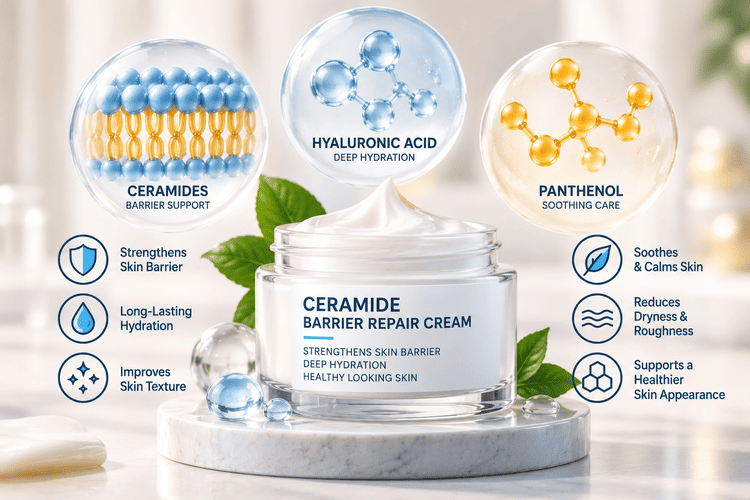
Ceramides and niacinamide are frequently associated with skin barrier-supporting skincare.
A related product concept is “Ceramide Barrier Repair Cream”.
Niacinamide and Tranexamic Acid
These ingredients may appear in skincare products targeting the appearance of uneven pigmentation.
For another specialized product category, explore “Tranexamic Acid Dark Spot Serum”.
Combining ingredients should always be based on technical compatibility and appropriate safety evaluation rather than marketing trends alone.
Why Is Niacinamide 10% + Zinc Serum Popular in Cosmetic Product Development?
Niacinamide 10% + Zinc Serum offers several commercial advantages for beauty brands.
First, niacinamide is a recognizable ingredient with established applications in modern skincare.
Second, the product concept addresses common consumer concerns, including oily skin, uneven tone, and visible pores.
Third, facial serums are well suited to premium skincare positioning because consumers often associate them with targeted ingredient delivery and specialized skin benefits.
Finally, niacinamide-based products can be incorporated into larger skincare collections.
A brand may develop a coordinated range containing a facial cleanser, niacinamide serum, moisturizer, and sunscreen.
This creates opportunities for complementary product sales and consistent brand positioning.
However, product differentiation should be based on actual performance, ingredient quality, sensory characteristics, and substantiated claims.
Important Considerations for Cosmetic Brands
Although niacinamide is widely used, developing a high-quality facial serum requires careful technical evaluation.
Important considerations include:
- Ingredient identity, purity, and supplier documentation.
- Selection of the appropriate zinc compound.
- Finished-product stability.
- pH compatibility and long-term ingredient integrity.
- Microbiological quality and preservation.
- Skin tolerability at the intended concentration.
- Packaging compatibility.
- Product appearance and sensory characteristics.
- Substantiation of cosmetic performance claims.
One technical consideration is the potential conversion of niacinamide to nicotinic acid under certain unfavorable conditions.
Nicotinic acid can produce flushing and irritation in some circumstances.
A properly designed product should therefore be evaluated for chemical stability under relevant manufacturing and storage conditions.
Packaging and Product Presentation
Packaging is an important part of the consumer experience.
Niacinamide serums are commonly presented in glass or plastic dropper bottles, pump dispensers, or airless packaging.
Each format offers different advantages.
Dropper bottles provide a recognizable premium skincare appearance, while pump and airless systems can reduce repeated exposure of the product to the surrounding environment.
Packaging selection should consider product viscosity, dispensing accuracy, ingredient compatibility, and microbiological risk.
For international cosmetic brands, label design must also reflect applicable ingredient declaration, safety, and product information requirements.
Regulatory Considerations for Niacinamide Serums
Niacinamide is an established cosmetic ingredient, but the finished product must still meet the applicable regulatory requirements of its intended market.
In the European Union, cosmetic products must comply with Regulation (EC) No 1223/2009, including safety assessment, product information file, labeling, and notification requirements.
In the United States, relevant requirements under the Federal Food, Drug, and Cosmetic Act and MoCRA must be considered.
Claims such as reduces the appearance of pores or improves the appearance of uneven skin tone are generally cosmetic in nature when properly substantiated.
Claims relating to treatment of acne or other medical conditions may change the product’s regulatory classification.
The use of 10% niacinamide does not automatically establish product safety or regulatory compliance.
Finished-product safety must be evaluated in the context of the complete formulation and intended use.
Custom Niacinamide 10% + Zinc Serum Formulation Development
For cosmetic brands, developing an exclusive Niacinamide 10% + Zinc Serum provides an opportunity to establish a distinctive product identity.
Although many commercially available serums contain similar headline ingredients, their texture, stability, moisturizing performance, and consumer experience can differ considerably.
A custom development project may focus on:
- Lightweight or premium serum positioning.
- Oily and combination skin applications.
- Fragrance-free skincare concepts.
- Skin barrier-supporting product collections.
- Ingredient preferences and sourcing requirements.
- Packaging and sensory characteristics.
- Target-market regulatory considerations.
The goal is to create a product that meets defined technical and commercial requirements rather than simply reproducing an existing market formula.
Cosmetic Formulation Development with FormulationMarket
At FormulationMarket, we support cosmetic brands, entrepreneurs, and product developers seeking exclusive skincare formulations.
Our cosmetic formulation development services are designed around the customer’s product concept, intended market, technical requirements, and manufacturing objectives.
For a Niacinamide 10% + Zinc Serum project, the development process begins with a review of the desired product characteristics and technical feasibility.
Depending on the agreed project scope, the technical package may include detailed ingredient information, formulation specifications, manufacturing procedures, quality-control guidance, and supporting technical documentation.
Our objective is to help clients develop technically structured cosmetic products that can be evaluated and manufactured by qualified production partners.
FormulationMarket provides cosmetic formulation research and development services; we do not commercially manufacture cosmetic products.
Brands interested in developing exclusive facial serums can visit www.formulationmarket.com to learn more about our custom cosmetic formulation services.
Frequently Asked Questions About Niacinamide 10% + Zinc Serum
What does Niacinamide 10% + Zinc Serum do?
It is commonly used to improve the appearance of oily skin, uneven skin tone, and visible pores while supporting skin conditioning. Actual benefits depend on the finished formulation and supporting evidence.
Is 10% niacinamide safe for daily use?
Many people tolerate niacinamide products, but 10% can cause irritation in some individuals. Daily suitability depends on the complete product and individual skin tolerance.
Does niacinamide shrink pores?
Niacinamide does not permanently reduce the anatomical size of pores. However, improvements in skin appearance and oiliness may make pores appear less noticeable.
Can niacinamide serum help with dark spots?
Niacinamide has been studied for improving the appearance of uneven pigmentation. Results depend on concentration, product design, consistent use, and the nature of the pigmentation concern.
Is zinc PCA the same as zinc oxide?
No. Zinc PCA is a skin-conditioning ingredient commonly used in facial skincare, while zinc oxide has different properties and applications, including use as a UV filter in certain sunscreen products.
Can niacinamide serum be used with vitamin C?
Yes, depending on the products involved. Niacinamide and vitamin C are not inherently incompatible in every skincare application.
Is 10% niacinamide better than 5%?
Not necessarily. Several cosmetic benefits have been demonstrated at lower concentrations, and a higher concentration may increase irritation for some users.
Can Niacinamide 10% + Zinc Serum be developed as a private label product?
Yes. Cosmetic brands can commission custom formulation development and arrange commercial production through a qualified cosmetic manufacturer.
Conclusion
Niacinamide 10% + Zinc Serum remains an important product concept within modern facial skincare because it combines recognizable ingredients with multifunctional cosmetic positioning.
Its applications extend beyond oily skin to include products targeting uneven skin tone, visible pores, hydration, and skin barrier support.
However, successful product development requires careful attention to ingredient selection, concentration, stability, tolerability, and substantiated cosmetic claims.
For cosmetic brands seeking differentiated products, custom niacinamide serum formulation development offers an opportunity to create skincare products with defined technical specifications, distinctive sensory characteristics, and consistent quality.
Through professional formulation research and development, businesses can transform established ingredient technologies into competitive products suitable for their intended markets.