Blog
Copper Peptide Serum: Benefits, GHK-Cu Technology, Skin Firmness and Cosmetic Formulation Development

Copper Peptide Serum is an advanced skincare product category attracting attention among cosmetic brands, skincare researchers, and consumers interested in premium anti-aging ingredients. Known for its distinctive copper-peptide complexes, this type of facial serum is commonly associated with skin conditioning, improved skin appearance, and the development of sophisticated skincare products.
Among the most recognized copper peptides is GHK-Cu, a copper-binding peptide complex that has been investigated for its biological properties and potential applications in skin-related research.
Copper peptides have become particularly interesting in cosmetic product development because they combine peptide technology with the properties of copper ions. Their scientific background has contributed to growing interest in products targeting the appearance of fine lines, uneven skin texture, and reduced skin firmness.
However, it is important to distinguish laboratory research, medical investigations, and demonstrated cosmetic performance. The presence of a copper peptide ingredient does not automatically establish that a finished serum stimulates collagen production, regenerates skin tissue, or reverses skin aging.
For cosmetic brands, Copper Peptide Serum offers opportunities to create differentiated skincare products with premium positioning, distinctive ingredient technology, and carefully defined cosmetic benefits.
This guide explains what copper peptide serums are, how GHK-Cu works, their potential skincare benefits, ingredient compatibility, skin suitability, product development challenges, and opportunities for custom cosmetic formulation development.
What Is Copper Peptide Serum?
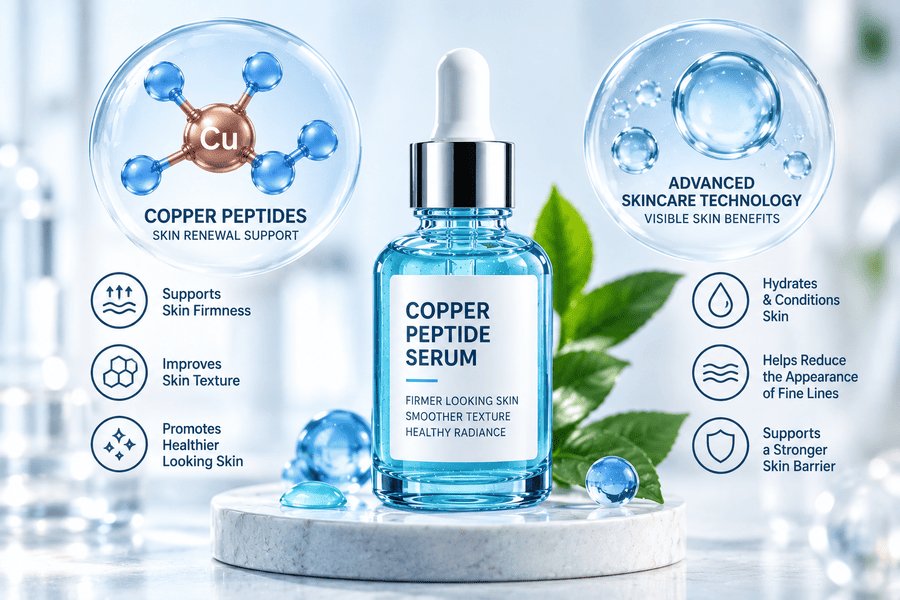
Copper Peptide Serum is a facial skincare product containing a copper-peptide complex, most commonly associated with Copper Tripeptide-1.
Copper Tripeptide-1 is the cosmetic ingredient name commonly used for the copper complex of the tripeptide GHK, which consists of glycine, histidine, and lysine.
When this peptide binds copper, it forms the complex known as GHK-Cu.
The copper ion is an important part of the complex’s chemical structure and contributes to its distinctive properties.
Copper peptide ingredients are often associated with blue-colored solutions, although the appearance of a finished cosmetic serum depends on the raw material, concentration, and other ingredients.
A Copper Peptide Serum may be developed to address cosmetic concerns such as:
- The appearance of fine lines and wrinkles.
- Reduced skin firmness.
- Uneven-looking skin texture.
- Dryness and dehydration.
- Dull or tired-looking skin.
- Overall skin conditioning.
The actual benefits depend on the finished formulation and the scientific evidence supporting its intended claims.
What Is GHK-Cu?
GHK-Cu is a naturally occurring copper-binding peptide complex that has been investigated in various areas of biological research.
GHK refers to the amino acid sequence glycine-histidine-lysine.
The peptide can bind copper ions, creating a complex with different chemical and biological characteristics from the unbound peptide.
Research has explored GHK-Cu in relation to processes involving extracellular matrix components, cellular signaling, and tissue biology.
These findings have encouraged interest in cosmetic applications.
However, results obtained in laboratory studies or experimental biological systems cannot automatically be applied to ordinary topical skincare products.
The performance of a Copper Peptide Serum depends on whether the selected ingredient remains stable, is available under the conditions of use, and produces measurable cosmetic benefits in the finished product.
How Do Copper Peptides Work in Skincare?
Copper peptides are investigated because of their interactions with biological systems and their potential relevance to skin-related processes.
Copper-Binding Properties
The GHK peptide can coordinate copper ions through its chemical structure.
This interaction produces the GHK-Cu complex.
The properties of the complex depend on its chemical identity, purity, and surrounding environment.
Skin-Conditioning Applications
Copper peptide ingredients are used in cosmetic products intended to maintain or improve skin condition.
Their cosmetic functions may include supporting the appearance of smoother, healthier-looking skin.
Extracellular Matrix Research
Some experimental research has investigated copper peptides in connection with extracellular matrix-related biological processes.
The extracellular matrix includes structural components such as collagen and elastin.
However, claims that a particular cosmetic serum increases collagen production or rebuilds skin structure require relevant finished-product evidence.
Antioxidant-Related Research
Copper-containing biological systems are associated with various oxidation-reduction processes.
Some copper peptide research has investigated antioxidant-related effects.
These findings should not be interpreted as proof that every copper peptide serum provides clinically meaningful antioxidant protection.
Potential Benefits of Copper Peptide Serum
Copper Peptide Serum is commonly positioned within premium anti-aging and skin-conditioning skincare.
Its potential benefits depend on the specific copper peptide ingredient, product design, and available performance data.
1. Improved Appearance of Fine Lines
Fine lines are among the most common cosmetic concerns associated with skin aging.
Selected copper peptide products may be developed to improve the appearance of fine lines.
Hydrating ingredients can also contribute to a smoother-looking skin surface.
Any specific wrinkle-reduction claim should be supported by suitable finished-product testing.
2. Skin Firmness and Elasticity
Copper peptide serums are frequently marketed for mature-looking skin.
Some products are positioned to improve the appearance of firmness and elasticity.
Instrumental measurements and controlled cosmetic studies may be used to evaluate these benefits.
3. Smoother-Looking Skin Texture
Skin texture can be influenced by hydration, environmental exposure, and age-related changes.
A well-designed serum may help improve the appearance and feel of the skin surface.
4. Skin Hydration
Copper peptide serums often contain complementary moisturizing ingredients.
These may improve hydration and reduce the appearance of dryness.
The moisturizing performance should be attributed to the complete formulation rather than automatically to the copper peptide ingredient.
5. Skin Barrier Support
A Copper Peptide Serum may be developed as part of a barrier-supporting skincare routine.
Complementary ingredients such as panthenol, glycerin, and selected lipids can contribute to skin comfort and hydration.
6. Premium Skincare Experience
Copper peptides are associated with advanced cosmetic ingredient technology.
This makes them attractive for premium skincare brands seeking differentiated product concepts.
Texture, absorption, packaging, and product appearance are important elements of the consumer experience.
Copper Peptide Serum vs Multi-Peptide Anti-Aging Serum
Copper Peptide Serum and “Multi-Peptide Anti-Aging Serum” are related but distinct skincare categories.
A copper peptide serum focuses on one or more copper-containing peptide complexes.
A multi-peptide serum contains two or more selected cosmetic peptides, which may or may not include copper peptides.
| Feature | Copper Peptide Serum | Multi-Peptide Anti-Aging Serum |
|---|---|---|
| Primary ingredient concept | Copper-peptide complex | Combination of selected peptides |
| Recognized ingredient | Copper Tripeptide-1 | Various cosmetic peptides |
| Typical positioning | Premium skin conditioning | Multifunctional anti-aging skincare |
| Ingredient compatibility | Requires attention to copper complex stability | Depends on selected peptide combination |
| Product appearance | May have a blue tint | Varies by ingredients |
| Development complexity | Copper coordination and stability considerations | Multiple peptide compatibility considerations |
Neither category is automatically superior.
The best choice depends on the intended product benefits, ingredient quality, and supporting evidence.
Copper Peptide Serum vs Retinol
Retinol and copper peptides are both associated with anti-aging skincare.
However, they differ significantly in chemistry, research background, and cosmetic applications.
Retinol is a vitamin A derivative with an established research history in photoaging-related skincare.
Copper peptides are peptide-metal complexes investigated for different biological and cosmetic properties.
Retinol-containing products may require particular attention to irritation, photostability, and regulatory restrictions.
Copper peptide serums have different technical considerations, particularly regarding ingredient compatibility and complex stability.
A copper peptide serum should not be marketed as providing the same effects as retinol without suitable comparative evidence.
Copper Peptide Serum vs Vitamin C Serum
“Vitamin C Brightening Serum” is commonly associated with antioxidant skincare and improving the appearance of uneven skin tone.
Copper Peptide Serum is more frequently positioned around skin conditioning, fine-line appearance, and premium peptide technology.
The ingredients also have different chemical characteristics.
Pure L-ascorbic acid is often formulated under acidic conditions and can participate in oxidation-reduction reactions.
Copper peptide complexes may be affected by interactions with certain formulation ingredients.
This does not establish that all vitamin C derivatives are incompatible with all copper peptides.
However, combining them requires ingredient-specific compatibility and stability evaluation.
For cosmetic brands, separate products may offer greater flexibility when different ingredients have conflicting technical requirements.
Can Copper Peptides Be Combined with Niacinamide?
Niacinamide is a widely used skincare ingredient associated with skin barrier support, uneven skin tone, and the appearance of oiliness.
It may be considered for use alongside copper peptide technology in appropriately designed skincare products.
However, compatibility must be established through technical evaluation.
The selected copper peptide raw material, niacinamide concentration, pH, and other ingredients can influence the finished product.
For more information about niacinamide skincare, explore “Niacinamide 10% + Zinc Serum”.
Can Copper Peptides Be Combined with Hyaluronic Acid?
Hyaluronic acid is commonly used in facial serums to support hydration.
It may complement the moisturizing characteristics of a copper peptide product.
However, hyaluronic acid ingredients differ in molecular weight, physical properties, and commercial form.
The finished formulation should be evaluated for stability, texture, and ingredient compatibility.
Copper Peptides and Skin Barrier Care
Skin barrier support is an important part of modern skincare.
A Copper Peptide Serum may be used alongside moisturizers designed to maintain hydration and skin comfort.
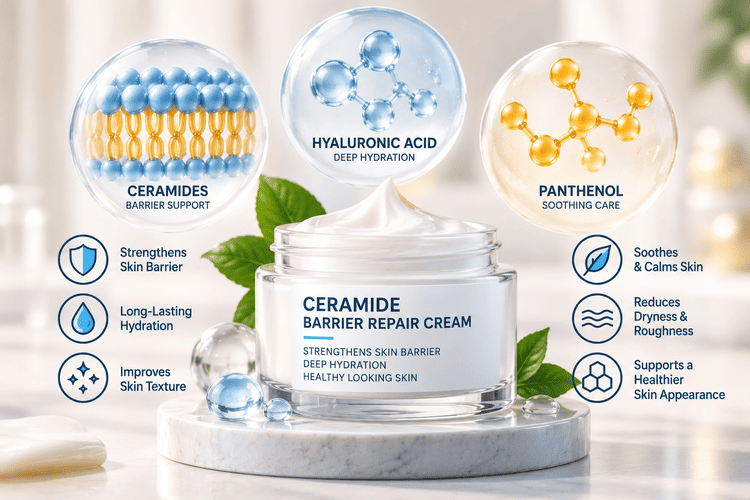
“Ceramide Barrier Repair Cream” is an example of a complementary product category.
Ceramides are lipid ingredients associated with the skin’s natural barrier structure.
A coordinated skincare collection may include a gentle cleanser, copper peptide serum, moisturizer, and sunscreen.
The objective is to create products with complementary cosmetic functions rather than relying on a single ingredient for every skincare concern.
Is Copper Peptide Serum Suitable for All Skin Types?
The suitability of a Copper Peptide Serum depends on its complete formulation.
Normal Skin
Copper peptide serums may be developed for normal skin with a focus on conditioning and maintaining skin appearance.
Mature Skin
Consumers with mature-looking skin may be interested in products targeting the appearance of fine lines, firmness, and texture.
Dry Skin
A copper peptide serum containing suitable moisturizing ingredients may contribute to improved skin hydration.
A separate moisturizer may still be necessary.
Combination Skin
Lightweight serum formats may appeal to consumers with combination skin.
Oily Skin
Non-greasy formulations may be suitable for consumers who prefer lightweight skincare.
Sensitive Skin
Sensitive skin requires additional consideration of tolerability.
A copper peptide ingredient does not automatically make a product suitable for sensitive skin.
Finished-product safety and tolerability testing are important.
Why Are Some Copper Peptide Serums Blue?
Copper peptide ingredients are often associated with blue coloration.
The color is related to the chemical characteristics of certain copper complexes.
However, the intensity of blue coloration is not a reliable indicator of product quality or efficacy.
A darker blue serum does not necessarily contain more active copper peptide or perform better.
Color can be influenced by the raw material, concentration, surrounding ingredients, and formulation conditions.
Manufacturers should evaluate ingredient identity and concentration using appropriate analytical documentation rather than relying on appearance alone.
Important Challenges in Copper Peptide Serum Development
Developing a high-quality Copper Peptide Serum requires careful technical evaluation.
Copper Peptide Identity
The selected ingredient must be accurately identified.
Different suppliers may provide Copper Tripeptide-1 in different commercial preparations.
Raw Material Purity
Raw material quality can influence product stability and consistency.
Appropriate supplier documentation should be obtained.
Complex Stability
Copper peptide complexes may be affected by certain ingredients and formulation conditions.
Maintaining the intended chemical characteristics of the ingredient is an important development consideration.
Ingredient Compatibility
Interactions with chelating agents, acids, other metal-binding compounds, and selected cosmetic ingredients should be evaluated.
Preservation
Water-based serums require appropriate microbiological quality control.
Preservative effectiveness should be assessed using the finished product.
Packaging Compatibility
Packaging should be selected according to product stability, dispensing characteristics, and contamination risk.
Product Performance Testing
Claims relating to skin firmness, wrinkle appearance, and texture should be supported by appropriate evidence.
Packaging Trends for Copper Peptide Serums
Copper peptide serums are frequently presented in premium packaging.
Common formats include:
- Glass dropper bottles.
- Airless pump dispensers.
- Opaque cosmetic bottles.
- Specialized skincare ampoules.
Blue-colored serum products are sometimes packaged in transparent containers to highlight their appearance.
However, packaging should be selected according to the actual product’s stability requirements rather than marketing aesthetics alone.
The finished formulation and packaging system should undergo compatibility testing.
How Long Does Copper Peptide Serum Take to Show Results?
The time required to observe cosmetic benefits depends on the finished product and intended outcome.
Hydration-related improvements may become noticeable relatively quickly.
Changes in the appearance of fine lines, firmness, or skin texture may require several weeks of consistent use.
However, there is no universal timeframe that applies to all copper peptide serums.
Specific performance claims should be supported by appropriate product studies.
Consumers should follow the manufacturer’s instructions and discontinue use if irritation occurs.
Copper Peptide Serum and Premium Skincare Trends
Copper peptides are increasingly associated with science-oriented skincare marketing.
Their appeal is influenced by consumer interest in peptides, biotechnology-inspired ingredients, and premium anti-aging products.
For cosmetic brands, this creates opportunities to develop specialized skincare collections.
Potential product concepts include:
- Premium copper peptide facial serums.
- Anti-aging peptide skincare collections.
- Lightweight daily conditioning serums.
- Copper peptide products for mature-looking skin.
- Multifunctional peptide and hydration treatments.
However, scientific credibility requires accurate ingredient descriptions and realistic cosmetic claims.
Brands should avoid using medical terminology to imply unproven regenerative effects.
Regulatory Considerations for Copper Peptide Cosmetics
Copper peptide ingredients must be evaluated according to the requirements of the intended market.
In the European Union, cosmetic products must comply with Regulation (EC) No 1223/2009, including applicable ingredient restrictions, safety assessment, labeling, and notification requirements.
In the United States, relevant provisions of the Federal Food, Drug, and Cosmetic Act and MoCRA must be considered.
Claims such as improves the appearance of fine lines or supports smoother-looking skin may be appropriate cosmetic claims when substantiated.
Claims involving wound healing, tissue regeneration, or treatment of skin diseases may change the regulatory classification of a product.
The presence of Copper Tripeptide-1 does not automatically establish finished-product safety or regulatory compliance.
Why Copper Peptide Serum Is Attractive for Cosmetic Brands
Copper Peptide Serum offers several commercial opportunities.
First, it is associated with premium ingredient technology.
Second, it can support targeted anti-aging skincare positioning.
Third, its distinctive ingredient identity allows brands to develop educational marketing content.
Fourth, copper peptide products can complement other facial serums and moisturizers within a coordinated skincare collection.
Finally, custom formulation development provides opportunities to differentiate products through texture, ingredient selection, packaging, and technical specifications.
Commercial success should be based on verified quality and consumer satisfaction rather than exaggerated claims.
Custom Copper Peptide Serum Formulation Development
Developing an exclusive Copper Peptide Serum allows cosmetic brands to establish their own product characteristics and commercial positioning.
A custom development project may focus on:
- Premium anti-aging skincare.
- Skin-conditioning benefits.
- Lightweight or moisturizing serum textures.
- Ingredient compatibility.
- Raw material quality.
- Packaging requirements.
- Product stability.
- Target production cost.
- Intended sales markets.
- Performance and safety testing.
The development process begins with defining the product concept and evaluating technical feasibility.
A professional formulation development project should also consider manufacturing conditions and the documentation required for commercial production.
Custom Cosmetic Formulation Services with FormulationMarket
At FormulationMarket, we provide custom cosmetic formulation research and development services for beauty brands, entrepreneurs, and businesses seeking exclusive skincare products.
Our services focus on developing technically structured cosmetic formulations according to the client’s intended market, product objectives, and manufacturing requirements.
For Copper Peptide Serum projects, we evaluate the desired product characteristics, ingredient technology, and technical feasibility.
Depending on the agreed project scope, a development package may include:
- Product definition and target specifications.
- Raw material selection and technical information.
- Laboratory formulation development.
- Manufacturing process documentation.
- Quality-control recommendations.
- Stability and compatibility guidance.
- Supporting technical documentation.
Exclusive formulation ownership and usage rights are established through the applicable contractual agreement.
FormulationMarket specializes in cosmetic formulation research and development. We do not commercially manufacture cosmetic products.
Clients may arrange commercial production through qualified cosmetic manufacturers after completing the necessary safety assessment, testing, validation, and regulatory procedures.
Visit www.formulationmarket.com to learn more about our custom cosmetic formulation development services.
Frequently Asked Questions About Copper Peptide Serum
What is Copper Peptide Serum?
Copper Peptide Serum is a facial skincare product containing a copper-peptide complex, commonly Copper Tripeptide-1, used in premium skin-conditioning and anti-aging skincare concepts.
What is GHK-Cu?
GHK-Cu is a copper-binding peptide complex formed from the tripeptide glycine-histidine-lysine and copper.
Does Copper Peptide Serum increase collagen?
Some experimental research has investigated copper peptides in relation to collagen-associated biological processes. However, increased collagen production cannot be assumed for a finished cosmetic serum without appropriate evidence.
Is Copper Peptide Serum better than retinol?
Neither ingredient category is universally superior. Retinol and copper peptides have different properties, evidence bases, and formulation requirements.
Can copper peptides be used with vitamin C?
Compatibility depends on the exact vitamin C ingredient, copper peptide preparation, and formulation conditions. A universal incompatibility rule is not scientifically justified.
Why is Copper Peptide Serum blue?
Certain copper complexes have characteristic blue coloration. Color intensity does not reliably indicate efficacy or product quality.
Is Copper Peptide Serum suitable for sensitive skin?
Suitability depends on the complete formulation and individual skin tolerance.
Can Copper Peptide Serum be used every day?
Many cosmetic serums are designed for regular use, but frequency should follow the finished product’s instructions and safety evaluation.
Can cosmetic brands develop exclusive copper peptide serums?
Yes. Custom formulation development can support the creation of copper peptide skincare products according to defined technical and commercial requirements.
Conclusion
Copper Peptide Serum represents an advanced category within premium anti-aging and skin-conditioning skincare.
GHK-Cu and related copper peptide technologies have attracted scientific and commercial interest because of their distinctive chemical properties and research background.
However, the performance of a finished cosmetic serum depends on ingredient quality, formulation stability, compatibility, safety, and appropriate supporting evidence.
For cosmetic brands, custom Copper Peptide Serum formulation development provides an opportunity to create differentiated skincare products with premium positioning and clearly defined technical specifications.
Through professional cosmetic formulation research and development, businesses can explore copper peptide technology while maintaining a focus on product quality, regulatory compliance, and realistic cosmetic benefits.