
Blog

What Is Custom Formulation Development? A Complete Guide for Brands and Manufacturers

What Is Custom Formulation Development? A Complete Guide for Brands and Manufacturers
Developing a successful chemical, cosmetic, detergent, or industrial product requires more than combining raw materials. Every commercial product must be designed to meet specific performance expectations, safety requirements, manufacturing conditions, and market demands.
This is where custom formulation development becomes essential.
Custom formulation development is the scientific and technical process of creating a product formulation according to the unique requirements of a brand, manufacturer, distributor, or entrepreneur.
Instead of relying on a generic, ready-made formula, businesses can develop products with specific ingredients, performance characteristics, manufacturing costs, and commercial objectives.
Whether you want to launch a premium skincare serum, develop an eco-friendly laundry detergent, manufacture an industrial degreaser, or create an exclusive private-label product, custom formulation development provides a structured approach to transforming a product idea into a technically defined formulation.
In this comprehensive guide, we explain how custom formulation development works, its benefits, the industries it serves, the documentation required, and how businesses can move from laboratory research to commercial manufacturing.
What Is Custom Formulation Development?
Custom formulation development is the process of designing and optimizing a product’s chemical composition to meet defined technical, functional, regulatory, and commercial requirements.
A formulation typically consists of multiple raw materials selected to perform specific functions.
Depending on the product category, these ingredients may include surfactants, solvents, emulsifiers, preservatives, active ingredients, fragrances, stabilizers, polymers, or other functional materials.
Each ingredient contributes to the overall characteristics of the finished product.
For example, a liquid laundry detergent formulation may require a carefully selected surfactant system, water-conditioning ingredients, viscosity control, fragrance compatibility, and preservation.
A facial serum may require different technologies, including humectants, cosmetic active ingredients, rheology modifiers, and a suitable preservation system.
An industrial cleaner may prioritize grease removal, material compatibility, foam control, and performance under specific operating conditions.
The objective of custom formulation development is to create a product that meets the customer’s requirements while remaining technically feasible and suitable for further validation.
Businesses can explore our custom formulation services to understand the available development categories.
Why Is Custom Formulation Development Important?
The global consumer and industrial product markets are highly competitive.
Many products may appear similar on store shelves, but their performance, raw material quality, stability, and production costs can vary significantly.
Custom formulation development allows businesses to create products that are differentiated according to their specific needs.
1. Product Differentiation
A custom formula can help a brand establish a distinctive product identity.
Rather than purchasing the same generic formula available to multiple competitors, companies can develop products with selected ingredients, textures, fragrances, and performance characteristics.
2. Performance Optimization
Different markets require different product characteristics.
A detergent developed for hard-water conditions may require a different technical approach from a detergent intended for soft water.
Similarly, an industrial cleaner designed for machine application may require low-foam performance that is not necessary for manual cleaning products.
3. Cost Control
Raw material costs have a direct impact on commercial profitability.
Custom development allows companies to evaluate alternative ingredients, supplier options, and formulation technologies.
Cost optimization must be balanced against product performance, safety, stability, and regulatory requirements.
Businesses seeking to improve existing products can explore our reformulation and cost optimization services.
4. Greater Manufacturing Flexibility
A properly documented custom formulation may be transferred to a qualified manufacturing facility.
This can reduce dependence on a single supplier, subject to formulation ownership rights, equipment compatibility, and successful production validation.
5. Product Innovation
Custom formulation development supports the exploration of new ingredient technologies and changing consumer preferences.
Examples include biodegradable cleaning products, concentrated detergents, premium skincare serums, and specialized industrial formulations.
Custom Formulation Development vs Ready-Made Formulations
One of the most important decisions for a new brand is whether to purchase an existing formula or commission a custom formulation.
Both approaches have advantages.
| Feature | Custom Formulation | Ready-Made Formulation |
|---|---|---|
| Product design | Developed around specific requirements | Existing formula |
| Ingredient selection | Customizable within technical limits | Usually predetermined |
| Product differentiation | Greater potential | Often limited |
| Development time | Requires R&D | Usually faster |
| Initial development cost | Generally higher | Often lower |
| Formula ownership | Defined by contract | Depends on supplier |
| Manufacturing flexibility | Potentially greater | Depends on licensing |
| Performance optimization | Based on project objectives | Limited to existing characteristics |
Ready-made formulations may be suitable for companies seeking a faster or lower-cost starting point.
Custom formulation development is particularly valuable when a business requires exclusive product characteristics, specific performance targets, or greater control over its technical documentation.
For businesses considering contract manufacturing, our private-label development and custom formulation services explain how product development can be aligned with commercial manufacturing requirements.
Which Industries Use Custom Formulation Development?
Custom formulation services are used across a wide range of consumer and industrial product categories.
Each industry has different technical requirements, testing expectations, and regulatory obligations.
1. Detergent and Cleaning Product Formulations
Detergent formulation development involves selecting suitable cleaning ingredients and optimizing their performance for a defined application.
Common product categories include:
- Liquid laundry detergents.
- Hand dishwashing liquids.
- Automatic dishwashing products.
- Floor and surface cleaners.
- Bathroom and toilet cleaners.
- Glass cleaners.
- Kitchen degreasers.
- Concentrated cleaning products.
- Low-foam machine cleaners.
- Robot vacuum cleaning solutions.
- Eco-conscious and biodegradable cleaning products.
A detergent formulation must balance cleaning performance with other important characteristics such as foam behavior, viscosity, stability, fragrance compatibility, and surface safety.
For example, a professional floor cleaner intended for automatic scrubber machines may require substantially different foam characteristics from a consumer floor-cleaning product.
Concentrated detergent development also introduces challenges related to ingredient compatibility, viscosity, and dilution performance.
Our Detergent & Cleaning Formulations service covers the development of customized cleaning products for household and professional applications.
2. Cosmetic and Personal Care Formulations
Cosmetic formulation development focuses on products intended for application to the skin, hair, and other external parts of the body.
Common cosmetic product categories include:
- Facial serums.
- Moisturizing creams.
- Anti-aging skincare products.
- Facial cleansers.
- Toners and emulsions.
- Body lotions.
- Hair conditioners.
- Hair masks.
- Scalp-conditioning serums.
- Specialized personal care products.
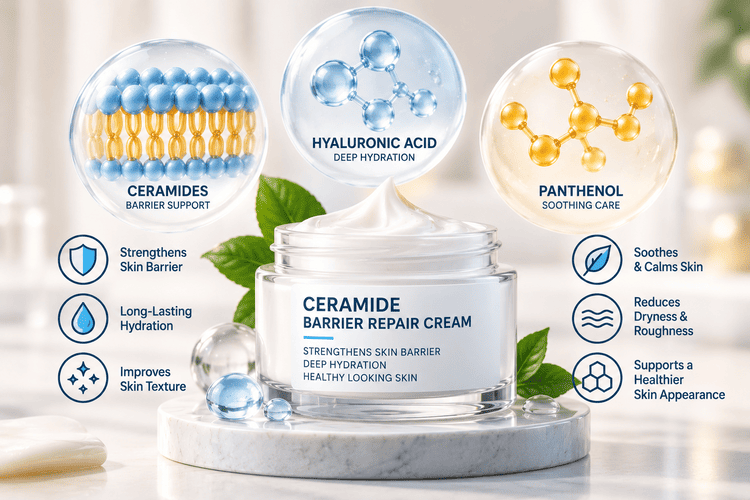
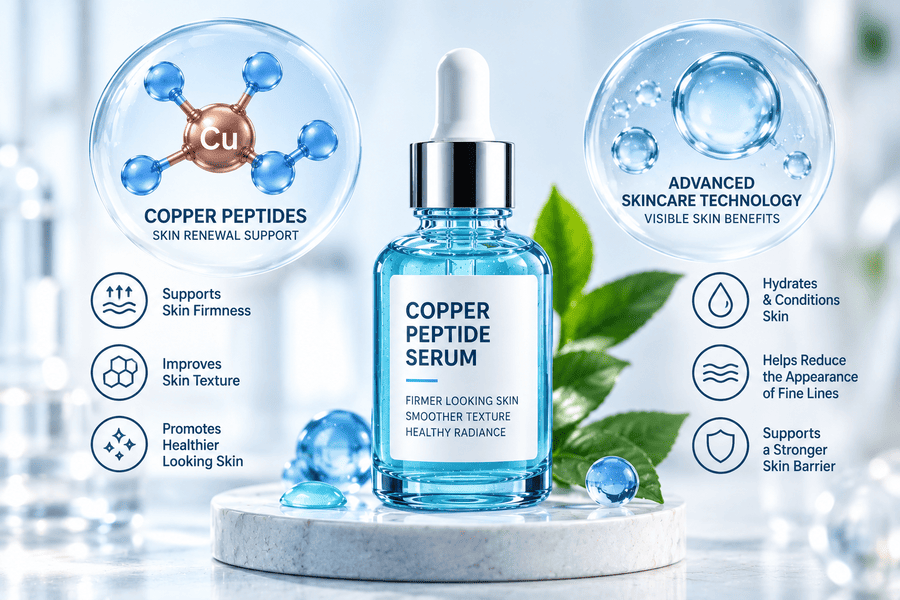
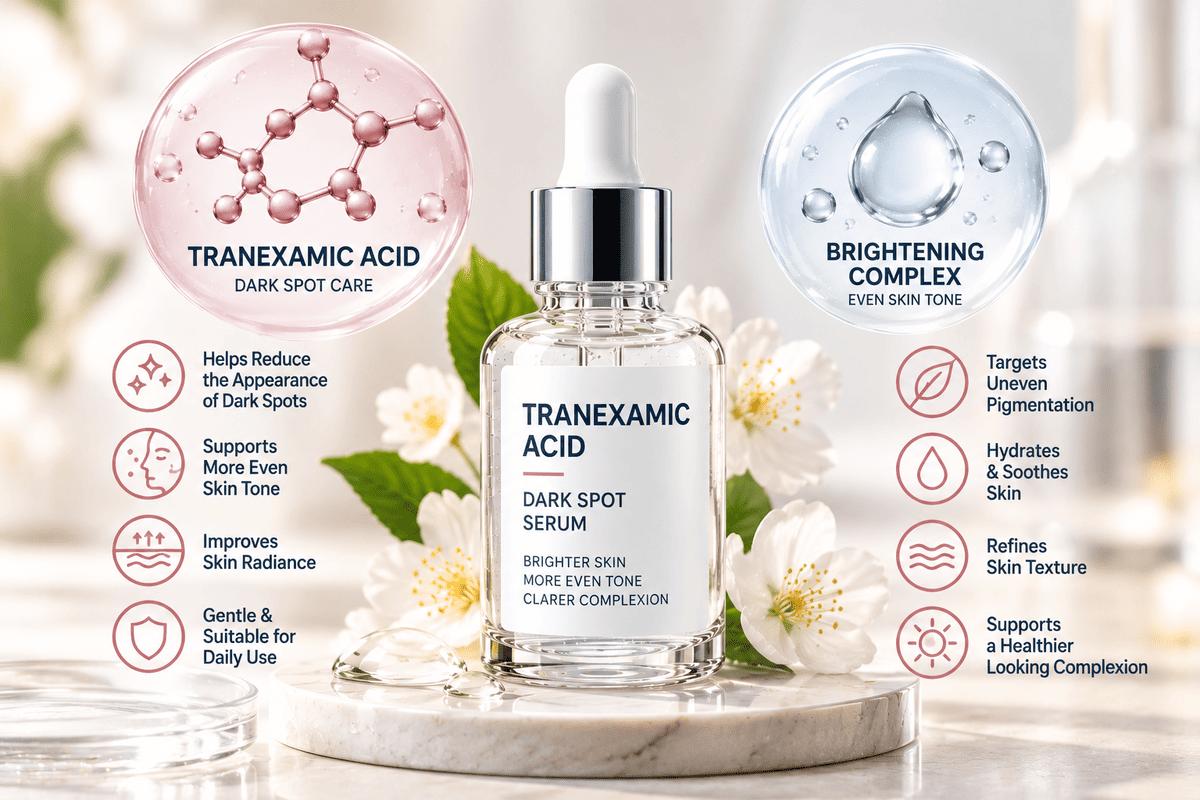
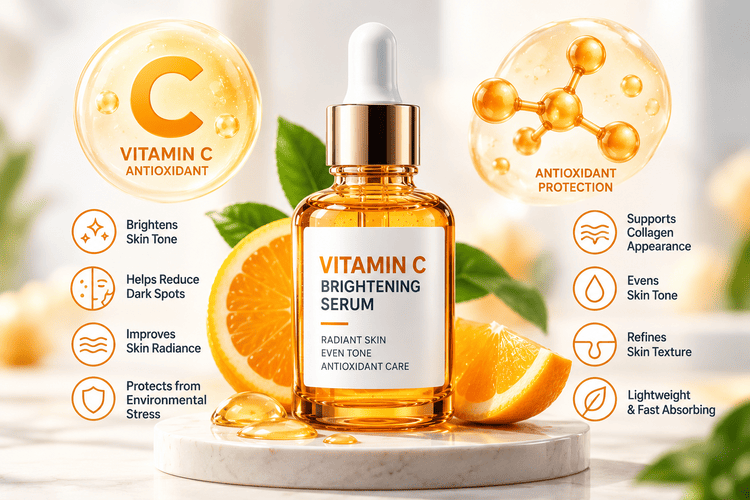
Popular skincare concepts include vitamin C brightening serums, niacinamide serums, copper peptide serums, ceramide moisturizers, and other advanced cosmetic ingredient technologies.
Cosmetic development requires careful consideration of ingredient suitability, stability, microbiological safety, skin compatibility, and intended marketing claims.
For example, a facial serum containing selected cosmetic peptides may require different compatibility considerations from a vitamin C product using an oxidation-sensitive ingredient.
The final product must undergo the appropriate safety and regulatory procedures before commercial distribution.
Explore our Cosmetic & Personal Care Formulations page for more information.
For businesses seeking exclusive cosmetic research and development, we also offer a dedicated Custom Cosmetic Development – Private R&D & Consultancy Service.
3. Industrial and Specialty Chemical Formulations
Industrial chemical formulations are developed for specific technical applications and operating conditions.
These products may require specialized performance characteristics that differ from conventional consumer products.
Examples include:
- Industrial degreasers.
- Machinery cleaners.
- Heavy-duty surface cleaners.
- Low-foam industrial cleaning concentrates.
- Specialized maintenance chemicals.
- Process-specific cleaning products.
- Technical surface treatment formulations.
Industrial formulation projects often involve evaluating compatibility with metals, plastics, coatings, seals, and other materials.
Additional considerations may include operating temperature, water hardness, chemical resistance, corrosion risk, and cleaning efficiency.
An industrial formulation must be developed according to its intended application rather than relying on general-purpose product assumptions.
Learn more about our Industrial & Specialty Formulations service.
4. Soap and Surfactant-Based Formulations
Surfactants are essential ingredients in many cleaning and personal care products.
They influence properties such as wetting, detergency, foaming, emulsification, and dispersion.
Soap and surfactant-based product development may involve:
- Liquid soap products.
- Surfactant-based cleaning liquids.
- Mild cleansing systems.
- Concentrated cleaning products.
- Specialty surfactant blends.
- Alternative surfactant technologies.
Surfactant selection can influence product performance, viscosity, stability, compatibility, and environmental characteristics.
The most appropriate surfactant system depends on the intended application and product requirements.
Visit our Soap & Surfactant-Based Formulations page to explore this category.
How Does the Custom Formulation Development Process Work?
Professional formulation development generally follows a structured sequence.
Although the exact workflow varies by product category, the following stages are commonly involved.
Step 1: Product Concept and Technical Requirements
The process begins by defining the intended product.
Important questions include:
- What product do you want to develop?
- Who is the intended customer?
- In which country will the product be sold?
- What performance characteristics are required?
- Are there preferred or prohibited ingredients?
- Is there a reference product?
- What is the target manufacturing cost?
- What packaging format will be used?
- What production equipment is available?
The more clearly the product requirements are defined, the easier it becomes to establish a realistic development plan.
Step 2: Raw Material Research and Selection
Once the product concept is defined, suitable raw materials are evaluated.
The selection process considers the intended function of each ingredient, technical compatibility, availability, cost, and regulatory suitability.
Depending on the product, the formulation may require surfactants, solvents, emulsifiers, stabilizers, active ingredients, preservatives, fragrances, or other functional materials.
Raw material selection should be based on appropriate technical documentation and verified specifications.
For companies seeking additional technical resources, our Raw Material Guides section provides a relevant starting point.
Step 3: Laboratory Formulation Development
Laboratory development involves preparing and evaluating experimental formulations.
The objective is to establish a technically suitable product composition and identify potential performance or stability problems.
Depending on the product, laboratory evaluation may include:
- Appearance.
- pH.
- Viscosity.
- Density.
- Foam characteristics.
- Cleaning performance.
- Emulsion stability.
- Ingredient compatibility.
- Fragrance stability.
- Sensory characteristics.
The relevant tests depend on the formulation category and intended application.
Step 4: Formulation Optimization
Initial laboratory results may identify areas requiring improvement.
A formulation may need adjustment to achieve the desired viscosity, appearance, stability, cleaning performance, or sensory characteristics.
Optimization can also address raw material cost and manufacturing practicality.
The goal is to achieve an appropriate balance between technical performance and commercial feasibility.
Step 5: Stability and Compatibility Evaluation
A formulation that performs well immediately after preparation may not remain stable throughout its intended shelf life.
Stability testing helps evaluate whether product characteristics remain acceptable under defined storage conditions.
Depending on the product, evaluation may involve temperature exposure, appearance changes, phase separation, viscosity variation, or other relevant parameters.
Packaging compatibility is also important.
Certain ingredients may interact with packaging materials, closures, pumps, or seals.
The final testing program should be established according to product-specific risks and applicable requirements.
Step 6: Manufacturing Process Development
A formulation must be suitable for practical production.
Manufacturing considerations may include equipment selection, mixing sequence, processing temperature, mixing intensity, and quality-control procedures.
A successful laboratory formula cannot automatically be assumed to perform identically at industrial scale.
The manufacturing process should therefore be evaluated before commercial production.
Step 7: Technical Documentation
After the agreed development work is completed, technical documentation is prepared.
A professional formulation dossier helps communicate the product’s composition, manufacturing requirements, specifications, and quality-control expectations.
This documentation is particularly important when the product will be manufactured by an independent production facility.
What Documents Are Included in a Professional Formulation Dossier?
A formulation dossier is a structured collection of technical information related to a product.
The exact documentation depends on the product category and project requirements.
Complete Formulation Document
This document identifies the selected raw materials and their intended proportions.
It provides the technical basis for preparing and evaluating the product.
Raw Material Information
Raw material documentation may include ingredient names, CAS numbers where applicable, INCI names for cosmetics, supplier specifications, and ingredient functions.
Manufacturing Instructions
Manufacturing instructions describe the intended preparation process, equipment requirements, order of addition, and important processing considerations.
Technical Data Sheet (TDS)
A Technical Data Sheet summarizes relevant product characteristics, specifications, and intended applications.
Businesses can explore our TDS Templates for technical documentation resources.
Safety Data Sheet (SDS)
A Safety Data Sheet provides standardized hazard and safety information for substances or mixtures within the applicable regulatory framework.
SDS requirements depend on the product and jurisdiction.
Cosmetic products in their finished state intended for the final user may be subject to different documentation rules from industrial chemical mixtures.
Explore our SDS & MSDS Templates for related resources.
Certificate of Analysis (COA)
A Certificate of Analysis reports the actual test results for a specific batch against defined specifications.
A COA template can be prepared during development, but a genuine batch COA must be completed using relevant analytical results.
Our COA Templates section provides supporting documentation resources.
Quality-Control Documentation
Quality-control documents may include recommended inspection parameters, manufacturing records, batch records, and testing templates.
Businesses developing production systems can explore our Manufacturing & Quality Control Templates.
Important: A formulation dossier does not automatically replace product-specific safety assessments, validated testing, regulatory approvals, or other mandatory documentation.
From Laboratory Formulation to Commercial Manufacturing
One of the most challenging stages of product development is transferring a laboratory formulation into commercial production.
A product prepared successfully in a small laboratory batch may behave differently when manufactured using industrial equipment.
This is known as formulation scale-up.
Why Is Scale-Up Important?
Industrial production introduces changes in mixing dynamics, heat transfer, ingredient addition, equipment geometry, and processing time.
For example, a laboratory mixer and a large industrial mixing tank may produce different shear conditions.
These differences can influence viscosity, emulsion characteristics, ingredient dispersion, and product stability.
Common Scale-Up Challenges
Manufacturers may encounter:
- Unexpected viscosity changes.
- Incomplete raw material dispersion.
- Excessive foam formation.
- Phase separation.
- Temperature control difficulties.
- Longer processing times.
- Differences in final product appearance.
- Batch-to-batch variation.
These issues should be evaluated through an appropriate pilot production and validation process.
Pilot Production
Pilot-scale production helps evaluate whether the proposed formulation and manufacturing procedure are suitable for larger equipment.
The process may identify adjustments needed before full commercial manufacturing.
Companies planning to move from laboratory development to production can explore our Production & Scale-Up Tools.
How Much Does Custom Formulation Development Cost?
The cost of custom formulation development depends on the complexity of the requested product and the required development work.
There is no universal price applicable to every formulation.
Important cost factors include:
Product Complexity
A conventional cleaning product may have different development requirements from a specialized cosmetic serum or industrial chemical system.
Ingredient Requirements
Specialized raw materials may increase research, sourcing, and laboratory costs.
Prototype Development
Projects requiring multiple physical prototypes or additional evaluations may involve greater development work.
Technical Documentation
The required documentation package influences the overall project scope.
Stability and Performance Testing
Independent testing, extended stability studies, microbiological evaluations, and other specialized assessments may involve additional costs.
Number of Revisions
The number and complexity of requested formulation changes can influence project pricing.
Regulatory Requirements
Market-specific regulatory consultancy, testing, and documentation may involve additional work.
At FormulationMarket, development projects are evaluated individually, and the price is determined according to the approved technical scope.
Businesses can request a custom formulation quotation by sharing their product requirements.
Who Owns a Custom Formulation?
Formulation ownership is an important commercial consideration.
Not every formulation development service automatically transfers intellectual property rights to the client.
Some providers retain ownership and grant limited manufacturing or usage rights.
Others offer exclusive formulation development with contractual ownership transfer.
Before beginning a project, businesses should clarify:
- Who owns the completed formulation?
- Can the client manufacture it independently?
- Can the client transfer the formula to another manufacturer?
- Are there restrictions on commercial use?
- What confidentiality obligations apply?
- Are background technologies or third-party rights excluded?
A clear written agreement helps reduce misunderstandings and supports long-term commercial planning.
At FormulationMarket, exclusive formulation ownership and permitted usage rights are established through the applicable project agreement.
What Is the Difference Between Formulation Development and Private Label Manufacturing?
Although these services are related, they serve different purposes.
Formulation development focuses on creating the technical composition and manufacturing instructions for a product.
Private label manufacturing focuses on producing and packaging products that will be sold under a customer’s brand.
A private-label manufacturer may offer an existing formula, a customized version of an existing product, or a fully developed exclusive formulation.
The exact arrangement depends on the manufacturer and commercial agreement.
Some companies prefer to purchase finished products from a single supplier.
Others prefer to own their formulation and select manufacturers independently.
Businesses exploring production partnerships can review our Private Label Development & Manufacturing service.
Can an Existing Product Be Reformulated?
Yes.
Reformulation involves modifying an existing product to achieve new technical, commercial, or regulatory objectives.
Common reasons for reformulation include:
- Reducing raw material costs.
- Replacing unavailable ingredients.
- Improving product stability.
- Adjusting viscosity or texture.
- Improving cleaning performance.
- Changing fragrance characteristics.
- Meeting updated regulatory requirements.
- Developing a more concentrated product.
- Responding to customer feedback.
Reformulation requires careful evaluation because changing one ingredient can affect multiple product characteristics.
For example, replacing a surfactant may influence cleaning performance, foam behavior, viscosity, and compatibility with other ingredients.
Our Reformulation & Cost Optimization Service supports businesses seeking technical improvements to existing products.
How Long Does Custom Formulation Development Take?
Development time varies depending on the product category and technical requirements.
A relatively straightforward formulation may require only a limited number of laboratory development stages.
More complex products may involve extensive ingredient research, multiple prototypes, and additional technical evaluations.
For suitable projects, initial formulation development and preparation of the agreed technical documentation may take approximately 3–4 weeks.
However, the complete product commercialization process may require additional time for:
- Stability testing.
- Packaging compatibility evaluation.
- Microbiological testing.
- Performance validation.
- Regulatory review.
- Pilot production.
- Manufacturing qualification.
A preliminary development schedule should be established during the project planning stage.
What Are the Most Common Formulation Development Mistakes?
Several common mistakes can create unnecessary costs or delays.
Choosing Ingredients Based Only on Marketing Trends
A popular ingredient is not necessarily appropriate for every product.
Ingredient selection should be based on technical suitability, safety, compatibility, and evidence.
Ignoring Manufacturing Conditions
A formulation that performs well in laboratory equipment may require modification for industrial production.
Underestimating Stability Testing
A visually acceptable laboratory sample does not establish long-term shelf life.
Failing to Define Product Specifications
Without clear specifications, it becomes difficult to evaluate consistency between batches.
Overlooking Regulatory Requirements
Ingredient restrictions and product classification can differ between countries.
Using Incomplete Technical Documentation
Missing manufacturing instructions or quality-control information can complicate production transfer.
Assuming Formula Ownership
Formulation ownership and usage rights should be confirmed contractually rather than assumed.
Avoiding these mistakes can improve the efficiency and commercial viability of product development.
How to Choose a Custom Formulation Development Partner
Selecting the right formulation development partner is an important business decision.
A suitable provider should be able to understand the intended product, evaluate technical feasibility, and define the expected development deliverables.
When comparing providers, consider:
Technical Experience: Does the provider have relevant experience in the requested product category?
Development Scope: Are laboratory development, prototypes, documentation, and revisions clearly defined?
Raw Material Knowledge: Can the provider evaluate suitable ingredients and alternatives?
Manufacturing Understanding: Are the proposed manufacturing instructions practical for the intended production environment?
Documentation Quality: Will the client receive sufficiently detailed technical information?
Confidentiality: Is an NDA available?
Ownership Rights: Are formulation ownership and usage rights clearly established?
Testing Requirements: Are additional testing and validation obligations explained?
A transparent project scope helps both parties understand the expected deliverables before development begins.
Custom Formulation Development with FormulationMarket
FormulationMarket provides custom formulation research, technical development, and consultancy services for businesses seeking specialized chemical and cosmetic products.
Our platform is associated with Star Kimya, a Turkish chemical manufacturing and formulation company established in 1993.
Our technical background includes detergent and cleaning chemical formulation, raw material evaluation, manufacturing processes, and product documentation.
We support projects across several formulation categories, including:
- Detergent and cleaning formulations.
- Cosmetic and personal care formulation development.
- Industrial and specialty chemical formulations.
- Soap and surfactant-based formulations.
- Private-label product development.
- Reformulation and cost optimization.
- Technical documentation and manufacturing consultancy.
For cosmetic projects, FormulationMarket provides formulation research and development services; commercial cosmetic manufacturing is arranged through qualified independent manufacturers.
Depending on the agreed scope, our services may include laboratory development, raw material selection, manufacturing documentation, quality-control recommendations, and technical consultancy.
Confidentiality arrangements and exclusive formulation ownership terms can be established through the relevant project agreement.
Our goal is to help businesses develop technically structured formulations that can proceed toward appropriate testing, validation, and commercial manufacturing.
Frequently Asked Questions About Custom Formulation Development
What is custom formulation development?
Custom formulation development is the process of creating a product formulation according to specific technical, performance, regulatory, and commercial requirements.
What types of products can be developed?
Common categories include detergents, cleaning chemicals, cosmetics, skincare products, soaps, surfactant-based products, and specialized industrial formulations.
Is custom formulation development suitable for startups?
Yes. Startups can commission formulation development without establishing a complete internal R&D department.
Can I own the formulation after development?
Yes, when ownership transfer is included in the development agreement. Intellectual property terms should always be confirmed contractually.
Can I manufacture my formula with another company?
This is possible when the client has the necessary formulation rights and the selected manufacturer can successfully validate the product.
Does a formulation package include manufacturing instructions?
A professional development package may include manufacturing procedures, equipment requirements, ingredient information, and quality-control guidance, depending on the agreed scope.
Does custom formulation development include SDS and TDS documents?
Technical documentation can be included in the development scope. The exact deliverables and regulatory requirements should be confirmed before the project begins.
How much does custom formulation development cost?
Pricing depends on product complexity, laboratory development requirements, prototypes, documentation, testing, and other project-specific factors.
How long does the development process take?
Suitable projects may require approximately 3–4 weeks for initial development and documentation. Additional testing and validation may extend the overall timeline.
Can an existing product be improved?
Yes. Reformulation can address cost, stability, performance, ingredient availability, and other technical objectives.
Do I need a factory to commission a formulation?
No. Businesses can commission formulation development before selecting a commercial manufacturing partner.
Can I request a confidential development project?
Yes. An NDA can be arranged before confidential technical and commercial information is exchanged.
Conclusion: Turn Your Product Idea into a Commercial Opportunity
Custom formulation development provides businesses with a structured approach to creating differentiated products that meet specific technical and commercial objectives.
Whether the goal is to develop a premium cosmetic serum, an eco-conscious cleaning product, a specialized industrial formulation, or an exclusive private-label product, successful development requires careful ingredient selection, laboratory evaluation, technical documentation, and manufacturing planning.
The value of a custom formulation extends beyond its ingredient list.
A properly developed and documented formulation can support product consistency, manufacturing flexibility, technical decision-making, and long-term brand development.
For businesses seeking professional formulation support, FormulationMarket offers customized research and development services across multiple chemical and cosmetic product categories.
Ready to develop your own formulation?
Request a Custom Formulation Quote and tell us about your product concept, target market, desired performance, and technical requirements.
FormulationMarket — Custom Formulation Development, Private R&D & Technical Consultancy.
Develop your formula. Own your technology. Build your brand.